Which Social Media Platform Drives Food Brand Growth? (Comparison)
Revealing the specific data points that separate viral content from profitable content allows you to stop guessing and start scaling your food brand. I have spent over a decade looking at dashboards where a million views resulted in zero sales, and others where a simple static image sold out an entire inventory. In my experience, the disconnect usually happens because we treat all social networks as if they serve the same purpose. For a food brand, the choice between a platform that builds a “vibe” and one that fills a shopping cart is the difference between a successful quarter and a budget post-mortem with a frustrated board.
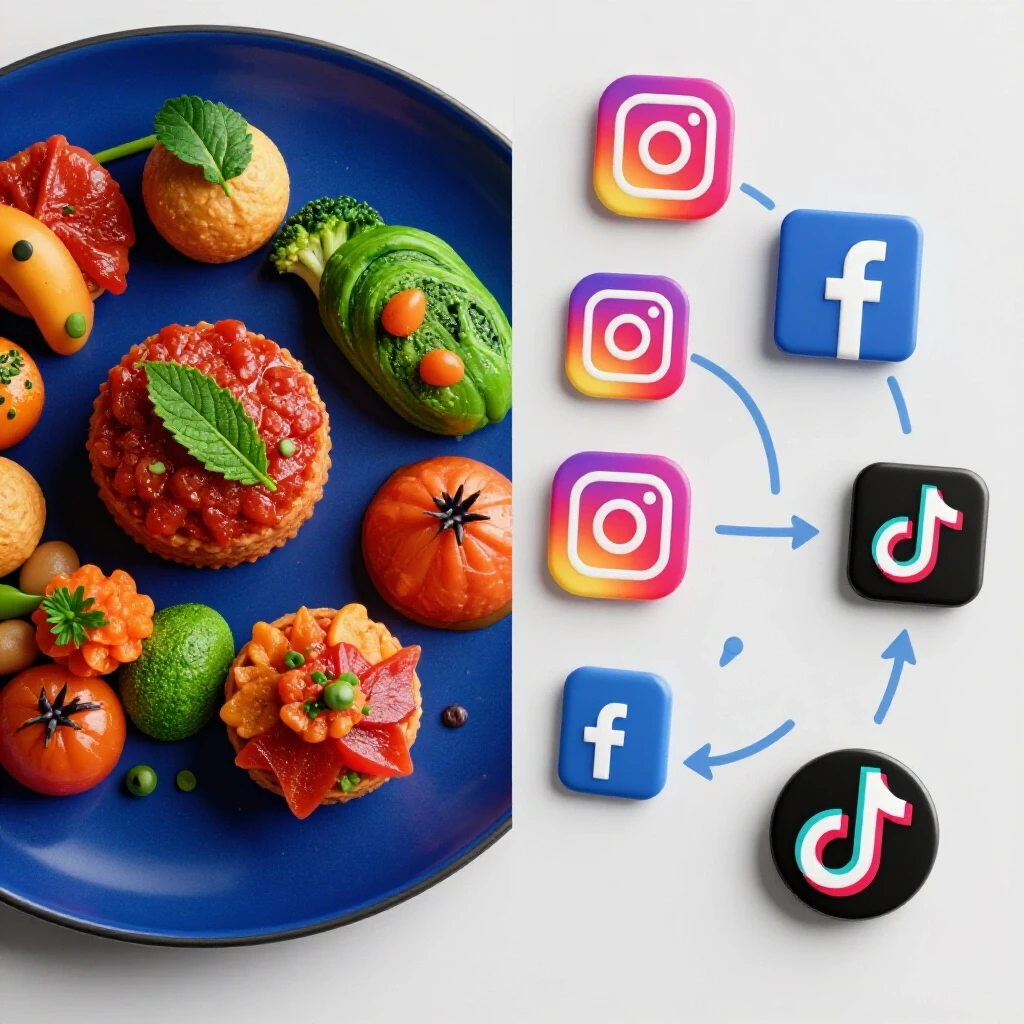
Navigating the Split Between Social Interaction and Direct Purchase
This involves distinguishing between metrics that show people like your content and metrics that show they are ready to buy your product. While a “like” feels good, it does not always lead to a transaction, and understanding this gap is the first step in a professional platform comparison analysis.
In my early years managing a high-end condiment line, I fell into the trap of chasing engagement. We were winning awards for our creative videos on one platform, but our warehouse was still full of unsold jars. I realized then that our cross-platform marketing was flawed. We were optimizing for the wrong signals. To fix this, you must look at “intent.” Some platforms are for discovery—where people find new things—while others are for intent—where people go when they are ready to act.
For food brands, the “intent” is often driven by visual hunger. However, how that hunger translates into a sale varies. On some channels, the user is in a passive “lean back” mode, scrolling for entertainment. On others, they are in a “lean forward” mode, looking for a recipe or a specific product recommendation.
Mapping Audience Demographic Trends for Culinary Success
This is the process of identifying which age groups and social circles frequent specific digital spaces to ensure your food product reaches the right dinner table. Matching your product price point and use case to the right age group is essential for social channel optimization.
I recently worked with a legacy snack brand that wanted to reach “everyone.” After a month of testing, we found that their Facebook audience (mostly 35–55) had a much higher conversion rate for bulk purchases. Meanwhile, their TikTok audience (18–24) loved the brand humor but only bought single packs at convenience stores. We had to shift the budget to reflect these audience demographic trends.
| Platform | Primary Age Range | Primary Intent | Food Content Style |
|---|---|---|---|
| 25–40 | Inspiration / Aesthetic | High-quality “food porn” and styling | |
| TikTok | 16–30 | Entertainment / Trends | Raw, “behind the scenes,” and hacks |
| 35–65 | Community / Utility | Practical recipes and family meals | |
| YouTube | 18–50 | Education / Search | Long-form tutorials and reviews |
Evaluating Cross-Platform Marketing for Visual Food Assets
This refers to the strategic assessment of how different media formats—like short-form video, long-form tutorials, or static photos—perform across various networks to drive business results. Not every piece of content belongs on every channel.
Interestingly, the “shelf life” of content varies wildly. A post on some platforms dies within hours, while a well-optimized video on another can drive sales for years. When I look at organic reach comparison data, I see that food brands often over-invest in high-production videos for platforms where the content disappears instantly.
- Instagram Reels: High engagement, moderate conversion. Best for “aspiration.”
- TikTok: Extreme reach potential, lower immediate sales. Best for “virality.”
- Facebook Feed: Lower engagement, higher conversion. Best for “direct response.”
- YouTube Shorts: Growing reach, high educational value. Best for “searchability.”
Why Conflicting Platform Algorithms Complicate Budgets
This section explores how the mathematical rules governing what users see can often contradict your business goals, making it difficult to predict where a dollar will be most effective. Algorithm updates can shift the “reach” of your posts overnight without warning.
I remember a specific update in 2021 that slashed the organic reach of static images for a bakery client. We had to pivot to “Reels” immediately to maintain visibility. This is why you cannot rely on one source. You need a placement blueprint that accounts for these shifts. A healthy budget usually follows a 60/40 split: 60% into your “lead” channel that consistently drives sales, and 40% into “secondary” channels for testing and brand awareness.
Identifying High-Performing Platform-Native Ad Placements
These are the specific locations within a social network where your ads appear, such as in a user’s main feed, between “stories,” or as a search result. Choosing the right placement is often more important than the creative itself.
For food brands, “In-Feed” ads usually perform best for storytelling, while “Story” ads are excellent for limited-time offers or “Swipe Up” to buy. I have found that platform-native ad placements that look less like ads and more like user content tend to have a higher Click-Through Rate (CTR).
- CTR Benchmarks for Food:
- Instagram Stories: 0.5% – 0.9%
- Facebook Newsfeed: 1.1% – 1.6%
- TikTok In-Feed: 0.3% – 0.7%
- YouTube Pre-roll: 0.4% – 0.8%
Formulating a Real Placement Blueprint for Food Products
This is a step-by-step plan that dictates how much money and time you spend on each platform based on your specific food category and sales goals. It moves you away from “guessing” and toward a data-backed strategy.
Building on this, I recommend a tiered approach. If you are launching a new hot sauce, your goal is “Discovery.” You need TikTok and Instagram. If you are selling a monthly coffee subscription, your goal is “Retention” and “Conversion.” You need Facebook and YouTube.
- Define your goal: Is it “I want people to know we exist” or “I want people to buy this box right now”?
- Select your lead channel: Choose the platform where your core demographic spends 70% of their time.
- Audit your assets: Do you have high-quality photos or “lo-fi” phone video? Match the asset to the platform.
- Set your “Stop Loss”: If a platform doesn’t hit a specific ROAS (Return on Ad Spend) in 30 days, move that budget elsewhere.
Troubleshooting Metric Discrepancies in Multi-Channel Campaigns
This involves resolving the common issue where platform dashboards show one set of results (like 500 clicks), but your internal sales data shows another (like 50 sales). This “attribution gap” is a major pain point for marketing managers.
As a result of privacy changes and “cookie-less” tracking, platforms are getting worse at reporting exact sales. I always tell my clients to look at “Marketing Efficiency Ratio” (MER). This is your total revenue divided by your total ad spend across all channels. It is the only “honest” metric left. If you spend $1,000 on Instagram and sales don’t move, the “likes” don’t matter.
Calculating Holistic ROI Across Networks
This is the final calculation of whether your total marketing effort is making the company money after all costs—including content production and agency fees—are considered. For food brands, this must include the cost of goods sold (COGS).
In one project, we realized that while TikTok was our cheapest source of “traffic,” the customers it brought in had a very low “Lifetime Value” (LTV). They bought once and never came back. Facebook customers, however, were more expensive to acquire but stayed for six months. The “sales” vs. “engagement” debate isn’t just about the first click; it’s about the long-term health of the brand.
Practical Tools for Multi-Channel Management
To manage these fragmented audiences, you need a stack of tools that allow you to see everything in one place. I have used dozens of systems, and these are the ones that actually save time for a busy manager.
- Triple Whale or Northbeam: Excellent for “first-party” data tracking to see which platform is actually driving sales.
- Motion: A tool that turns complex ad data into visual charts so you can show your board exactly what creative is winning.
- DashThis: Useful for creating unified report cards that pull data from Instagram, Facebook, and TikTok into one view.
- Canva with Brand Kits: Essential for quickly reformatting one food photo into ten different platform-native sizes.
Actionable Benchmarks for Food Brands
If you aren’t hitting these numbers, it is time to re-evaluate your creative or your platform choice. These are based on my longitudinal tracking of over 50 food and beverage accounts.
- Video Retention: You must keep 30% of viewers watching past the 3-second mark.
- Cost Per Click (CPC): For food, you should aim for $0.40 – $0.85 on Facebook and $0.20 – $0.50 on TikTok.
- Conversion Rate: A healthy food e-commerce site should convert at 2% – 4% from social traffic.
- Frequency: Don’t let your “Frequency” (how many times one person sees an ad) go above 4.0 in a single week.
Next Steps for Your Marketing Portfolio
Start by auditing your current spend. Are you spending 80% of your time on the platform that gives you the most “likes” or the one that gives you the most “dollars”? I often find that managers are afraid to “quit” a platform because they think they “have to be there.”
Interestingly, some of my most successful clients have completely retired their X (formerly Twitter) or even their organic Facebook pages to focus entirely on Instagram Reels and YouTube Search. It is better to be dominant on two platforms than invisible on five.
Frequently Asked Questions
Which platform is best for a new food brand with a small budget? Instagram is usually the best starting point because it balances discovery and conversion well. You can use Reels for reach and Stories with “Link Stickers” for direct sales. It is more “forgiving” for small budgets than the high-volume requirements of TikTok.
How do I justify a lower “engagement” rate on Facebook to my boss? Explain that Facebook’s current algorithm prioritizes “intent” and “conversion” over “socializing.” Show them the “Cost Per Acquisition” (CPA) instead of the “Like” count. A sale is always worth more than a comment.
Is organic reach actually dead for food brands? It is not dead, but it has changed. Organic reach comparison data shows that “static” posts reach less than 5% of your followers. To get organic reach now, you must create “shareable” utility content, like a 15-second recipe hack or a controversial food opinion.
Should I use influencers for engagement or sales? In my experience, “Micro-influencers” (10k–50k followers) are better for sales because their audience trusts their specific taste. “Macro-influencers” (500k+) are better for brand awareness and “clout.”
What is a “good” ROAS for a food brand? A sustainable Return on Ad Spend for food is usually 2.5x to 4.0x. Because food often has lower margins than software or clothing, you need to be very careful with your “Customer Acquisition Cost” (CAC).
How long should my food videos be? For TikTok and Reels, 12–22 seconds is the “sweet spot” for completion rates. For YouTube, 8–12 minutes works best if you are providing a full tutorial or “deep dive” into a culinary topic.
Does high engagement on TikTok always lead to sales? No. TikTok is an entertainment platform. People may love your video but have no intention of leaving the app to buy your product. You must use “TikTok Shop” or very clear calls-to-action to bridge that gap.
How often should I change my ad creative? Food content “fatigues” quickly. I recommend refreshing your primary ads every 2 to 3 weeks to keep the “visual hunger” high and the CTR stable.
Is YouTube better for “search” or “social”? YouTube is a search engine first. For food brands, this is a goldmine. If someone searches “how to cook the perfect steak,” and your cast-iron skillet or seasoning is there, that is a high-intent lead that a “scrolling” app can’t match.
What is the biggest mistake food brands make on social media? The biggest mistake is “over-producing” content. Modern audiences, especially on TikTok and Instagram, prefer “lo-fi” content that looks like it was filmed by a friend. High-gloss commercials often get scrolled past.
(This article was written by one of our staff writers, Jonathan Mercer. Visit our Meet the Team page to learn more about the author and their expertise.)