LinkedIn Ads vs Google Ads for B2B Pipeline Growth (Guide)
The opportunity for growth in the professional sector has never been more precise. Today, we can reach a Chief Technology Officer not just by what they type into a search bar, but by the very seat they occupy at their company. For over a decade, I have watched the tension between these two methods grow. On one side, we have the power of immediate intent. On the other, we have the power of professional identity. The real win for a marketing manager is not choosing one over the other, but knowing exactly when to use each to move a prospect through the sales funnel.
In my years managing brand presence across platforms like Instagram, TikTok, and the major professional networks, I have seen many budgets fail because they treated every channel the same. I once worked with a software firm that spent its entire quarterly budget on high-intent search terms. They captured every person looking for “cloud security,” but their cost-per-click (CPC) skyrocketed to fifty dollars. They were winning the click but losing the margin. By shifting a portion of that spend to a platform that targeted specific job titles, we built a pipeline of qualified leads who weren’t even searching yet. This balanced approach is what I want to explore with you today.
Distinguishing Intent-Based Search from Professional Persona Targeting
Understanding the difference between a user actively seeking a solution and a user who matches a specific job profile is the first step in effective budget allocation for enterprise growth. This distinction helps you decide if you are catching a falling leaf or planting a new tree.
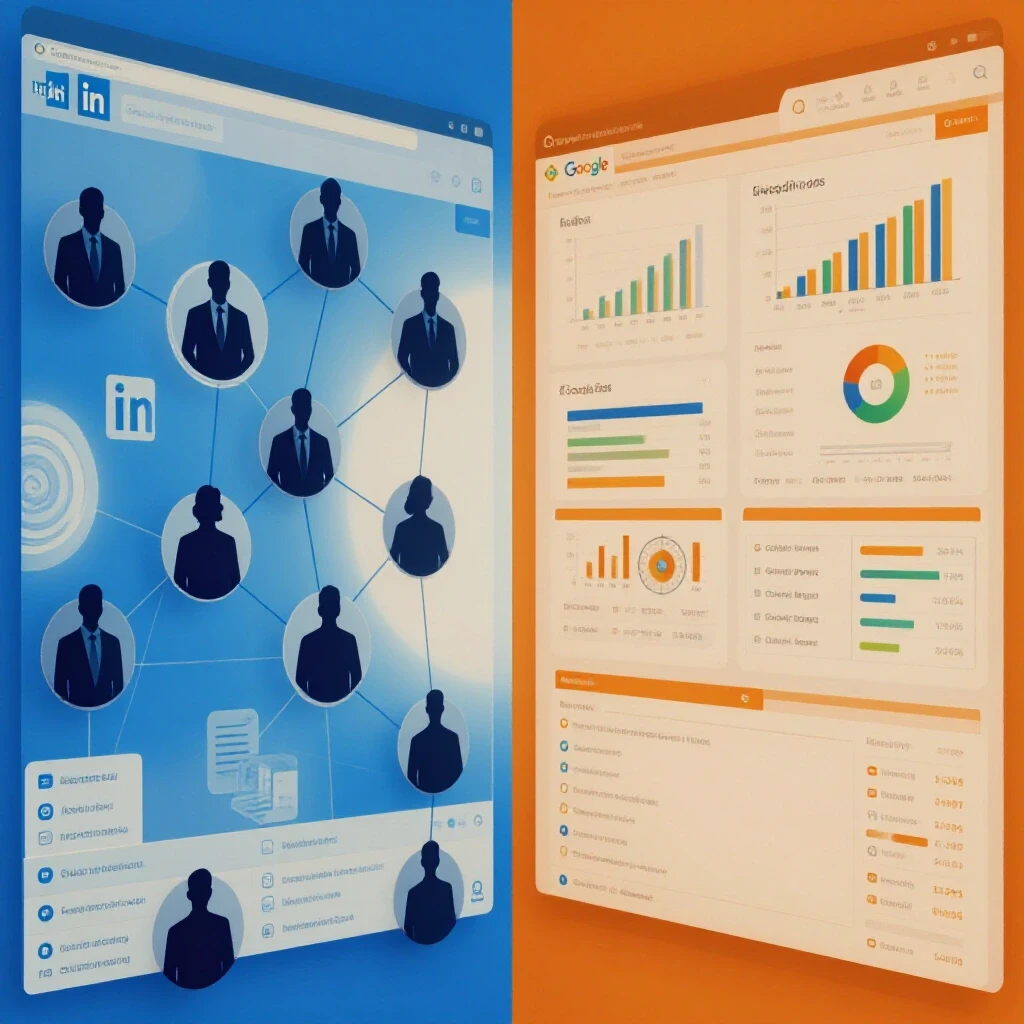
In the world of professional services, we often talk about “pull” and “push” marketing. Search engines provide a “pull.” A user has a problem and types it into a box. They are signaling that they want a solution right now. Professional social networks provide a “push.” You are showing your solution to someone because their job title suggests they might need it, even if they aren’t looking today.
When I conduct a platform comparison analysis, I look at how these two behaviors impact the sales cycle. According to research from the Reuters Institute, professional users are becoming more selective about where they consume news and business data. This means your ad must feel native to their experience. If they are in “research mode” on a search engine, a text ad works. If they are in “networking mode” on a social platform, a visual case study performs better.
Managing Fragmented Data and Conflicting Algorithm Signals
Marketing managers often struggle with mismatched metrics between social feeds and search results, making it difficult to prove which dollar actually shortened the sales cycle. This fragmentation is one of the biggest hurdles in cross-platform marketing.
Algorithms on social platforms prioritize engagement and “dwell time,” which is how long a user stays on your post. Search algorithms prioritize relevance and “click-through rate” (CTR). When you look at your dashboard, it might look like your social ads are failing because the CTR is 0.5%, while your search ads have a 4% CTR. However, the social ad might be seen by five different decision-makers at the same company, creating “account-based” awareness that search cannot match.
I remember a project where a client wanted to cut their social spend because the “last-click” attribution was low. We ran a test where we turned off social ads in three specific regions. Within two months, the search volume for their brand name in those regions dropped by 30%. This longitudinal data proved that the social channel was feeding the search channel.
Comparison of Audience Demographic Trends and Intent Levels
The following table outlines how different platforms handle user data and how that influences your ability to target the right professional at the right time.
| Feature | Search-Based Advertising | Professional Social Advertising |
|---|---|---|
| Primary Targeting | Keywords and Search Intent | Job Title, Company, Seniority |
| User Mindset | Problem-Solving / Active Buying | Networking / Industry Learning |
| Average CPC (B2B) | $3.00 – $20.00+ | $6.00 – $15.00+ |
| Lead Quality | High (Ready to Buy) | High (Ideal Fit) |
| Audience Reach | Limited by Search Volume | Scalable by Persona Size |
| Typical CTR | 2% – 5% | 0.4% – 0.6% |
Why Conflicting Platform Algorithms Complicate Budgets
Algorithms are essentially recommendation engines that decide who sees your content based on past behavior and platform-native retention signals. These signals are not the same across the board, which can lead to confusing reports for your executive board.
On a professional social network, the algorithm wants to keep users on the platform. If your ad leads to a high-quality conversation in the comments, the platform might reward you with lower costs. On a search engine, the goal is to get the user to the best answer as fast as possible. These different goals mean your creative assets must be tailored. A long, thought-leadership video might thrive on a social feed but would be ignored as a search result.
In my experience, trying to force a search-style “Buy Now” ad into a social feed is a rookie mistake. It ignores the social channel optimization required to build trust. Professionals on social media want to be educated, not sold to immediately.
Formulating a Real Placement Blueprint for Enterprise Leads
A successful strategy involves mapping your placements to the buyer’s journey. You cannot expect a single platform to do everything. You need a blueprint that accounts for both the “what” and the “who” of your target market.
- Top of Funnel (Awareness): Use professional social networks to target by firmographics. This includes company size, industry, and job function.
- Middle of Funnel (Consideration): Use search ads for “non-branded” keywords. These are terms related to the problem your product solves.
- Bottom of Funnel (Conversion): Use “branded” search terms and social remarketing. This ensures that when someone searches for your company by name, you own that space.
I often suggest a 60/40 budget split. Put 60% of your budget into your “lead” channel—usually search if you have a high-demand product. Put 40% into your “support” channel—usually social—to build the brand and reach people who aren’t searching yet.
Optimizing Ad Placements for High-Value Pipeline Results
Platform-native ad placements are the specific spots where your ads appear, such as the news feed, the sidebar, or the top of a search results page. Each placement has a different “vibe” and expected behavior.
For example, a “Sponsored InMail” or direct message ad on a professional network can feel very intrusive if the offer isn’t right. However, a “Sponsored Content” post that looks like a regular update feels more natural. On the search side, “Extension Links” that show your pricing or a demo page can significantly increase your CTR by giving the user exactly what they want.
- Social Feed Ads: Best for white papers, webinars, and brand stories.
- Search Text Ads: Best for direct demos, free trials, and “contact sales” requests.
- Display/Banner Ads: Best for staying top-of-mind (remarketing) rather than initial lead capture.
Troubleshooting Metric Discrepancies Across Networks
One of the hardest parts of being a marketing manager is explaining why Google says you had 100 conversions while LinkedIn says you had 50. These discrepancies often come from different “attribution windows.”
An attribution window is the period of time a platform tracks a user after they click or view an ad. If a user clicks a social ad on Monday but doesn’t buy until Friday after clicking a search ad, both platforms might try to take credit. To solve this, I recommend using a neutral third-party tracking tool or a “first-party” data system. This allows you to see the entire path a lead took before they filled out a form.
- Check your tracking tags: Ensure your “pixels” and “tags” are firing on every page of your site.
- Use UTM parameters: Add unique codes to the end of your URLs so you can see exactly which ad a lead came from in your CRM.
- Look at “Assisted Conversions”: This metric shows you which platforms helped a sale, even if they weren’t the final click.
Evaluating Holistic ROI Through Pipeline Velocity
Return on Investment (ROI) in B2B isn’t just about the cost of a lead. It is about how fast that lead moves through your pipeline and how much they eventually spend. This is called pipeline velocity.
I once managed a campaign where the search leads were 20% cheaper than the social leads. On the surface, search was the winner. However, when we looked at the CRM data six months later, the social leads closed 15% faster and had a 30% higher contract value. The social targeting allowed us to reach “Enterprise” level accounts, while the search ads were attracting smaller “Prosumer” leads.
To calculate true ROI, you must track: * Cost Per Qualified Lead (CPQL): Not just any lead, but one that fits your target profile. * Sales Accepted Lead (SAL) Rate: The percentage of leads the sales team actually wants to call. * Customer Acquisition Cost (CAC): The total spend divided by the number of new customers.
Setup Verification Checklist for Multi-Channel Campaigns
Before you launch any campaign, go through this list to ensure your budget isn’t being wasted on technical errors.
- Conversion Tracking: Is the “Thank You” page pixel working?
- Audience Overlay: Are you accidentally targeting the same people with different ads and bidding against yourself?
- Mobile Optimization: Does your landing page load in under three seconds on a smartphone?
- Lead Magnet Alignment: Does the offer in the ad match the headline on the landing page?
- Exclusion Lists: Have you excluded your current customers and employees from seeing your acquisition ads?
Managing Executive Expectations During Algorithm Shifts
Algorithms change constantly. In my decade of experience, I have seen organic reach decay on almost every major platform. This means you have to pay more to get the same results you got three years ago. When reporting to a board, be transparent about these shifts.
Explain that “platform-native retention” is the new goal. Platforms want users to stay, so ads that provide value without forcing a click-away often get better placement. Use data from independent sources like eMarketer to show that your rising costs are an industry trend, not a failure of your strategy.
I once had to tell a client that their “viral” strategy was no longer working because the platform changed its API. We had to pivot to a “paid-first” model. It was a hard conversation, but by showing the longitudinal data of declining organic reach, they understood the need for a dedicated ad budget.
Practical Steps for Reallocating Underperforming Budgets
Don’t be afraid to kill an ad or a channel that isn’t working. I have retired many social accounts that were simply “noise” and didn’t contribute to the bottom line.
- Audit monthly: Look for channels where the CPQL is more than double your average.
- Test the “Why”: Before cutting, try a new creative or a different landing page.
- Shift slowly: Move 10-20% of the budget at a time. Drastic shifts can confuse the platform’s learning phase.
- Reinvest in winners: If your search ads are hitting their daily limit and still delivering high-quality leads, give them more fuel.
Conclusion and Next Steps for Pipeline Growth
The path to a strong return on investment is not found in a single platform. It is found in the balance between capturing existing demand and creating new interest. Start by auditing your current “cost per qualified lead” across both search and social. Look for the “attribution gap” where leads might be seeing your social ads but only converting through search.
For your next quarterly planning session, try building a “unified report card.” This should show not just clicks and impressions, but how each channel contributes to the total number of sales-qualified opportunities. By focusing on business outcomes rather than platform-specific vanity metrics, you will be able to justify your budget with confidence and clarity.
FAQ: Navigating Professional Advertising and Pipeline Results
Which platform is better for a small B2B budget? Search-based advertising is often better for small budgets because you only pay when someone is actively looking for your solution. It provides a more immediate return on investment. Professional social networks often require more “testing” budget to find the right audience and creative fit.
How do I handle the loss of third-party cookies? Focus on “first-party” data. This means collecting email addresses through lead magnets like white papers or webinars. Use these emails to build “Matched Audiences” on your ad platforms, which does not rely on cookies.
What is a good CTR for a B2B social ad? A healthy CTR for a sponsored post on a professional network is typically between 0.4% and 0.6%. If you are above 1%, your creative is performing exceptionally well. If you are below 0.3%, you likely have a mismatch between your audience and your offer.
Should I bid for “clicks” or “conversions”? If you have a new account with little data, start by bidding for clicks to get traffic moving. Once the platform has recorded 30 to 50 conversions, switch to “conversion-based” bidding. This allows the algorithm to find people similar to those who have already signed up.
How often should I change my ad creative? In a professional social feed, “ad fatigue” happens quickly. I recommend refreshing your visuals and headlines every 4 to 6 weeks. Search ads can last much longer since they are only shown to people searching for specific terms.
Is it worth advertising on “niche” professional groups? Yes, but the volume is often low. Niche targeting is great for high-value enterprise deals where you only need a few “whales” to make the campaign profitable.
What is the best way to track “offline” conversions? Most major platforms allow you to upload a CSV file of your closed deals. The platform then matches those emails to the users who saw your ads. This is the best way to see the true “closed-won” ROI of your marketing spend.
Does organic activity help my paid ads? Yes. Platforms often give a “relevance score” to your brand. If your organic posts get good engagement, your paid ads may see a lower cost-per-click because the platform views your brand as a high-quality contributor to the community.
What is “firmographic” targeting? Firmographic targeting is like “demographic” targeting but for companies. It includes targeting by company size, annual revenue, location, and industry type. It is essential for ensuring your B2B ads only reach businesses that can afford your services.
Should I use “Lead Gen Forms” or send people to my website? Lead Gen Forms (which stay inside the platform) usually have a higher conversion rate because they are easier for the user. However, the lead quality can sometimes be lower. Sending users to your website allows you to educate them more deeply, but you will lose more people in the process. I suggest testing both.
(This article was written by one of our staff writers, Jonathan Mercer. Visit our Meet the Team page to learn more about the author and their expertise.)