How to Fix Common Lead Generation Mistakes in Social Media (Guide)
Have you ever watched your campaign metrics climb while your actual business results remained stagnant? Over my 11 years as a social media strategist, I have managed more than 40 account growth journeys across Instagram, TikTok, and LinkedIn. I have seen countless campaigns that looked successful in a dashboard but failed to generate a single dollar in revenue. This disconnect usually stems from a recurring error in how we approach lead capture: prioritizing the quantity of contacts over the quality of the connection.
In my early years, I focused heavily on reducing friction. I wanted the shortest forms and the easiest clicks. I thought that more leads always equaled more success. However, after tracking the full lifecycle of dozens of campaigns, I realized that making it too easy for people to sign up was actually my biggest hurdle. This guide will detail how I identified this pattern of low-intent sign-ups and the specific steps I took to fix it using data-backed pivots and platform-native tools.
Establishing a Baseline for High-Quality Social Media Growth Strategy
A social media growth strategy is the foundational plan that dictates how an account will attract and retain its target audience. It involves setting baseline metrics, which are the starting performance numbers used to measure future success. Establishing these benchmarks allows you to see when a campaign is truly underperforming versus when it is simply experiencing a natural platform dip.
Before launching any campaign, I define what a “win” looks like beyond just a lead count. For an intermediate marketer, this means looking at the campaign lifecycle management from a holistic view. You cannot just track clicks; you must track the journey from the first impression to the final conversion. In my experience, a healthy campaign usually follows a predictable timeline of learning, optimization, and scaling.
When I start a new project, I look at three specific areas to set my baseline:
- Algorithmic Reach Distribution: This is the way platforms like Instagram or TikTok decide who sees your content. I look at historical data to see if the account’s reach is primarily coming from followers or the “For You” page.
- Audience Retention Percentages: I analyze how long people watch videos or how deep they scroll through carousels. If retention drops off before the call-to-action, the lead quality will suffer.
- Standard Engagement Rates: I establish a “normal” range for likes, comments, and shares. This helps me spot “ghost leads”—people who sign up but never actually engage with the brand again.
By setting these baselines, I can tell within 14 to 30 days if a campaign is going to hit its goals or if it needs a strategic pivot. Without this historical precedent, you are just guessing.
Why Volume-First Lead Generation Often Leads to Campaign Stagnation
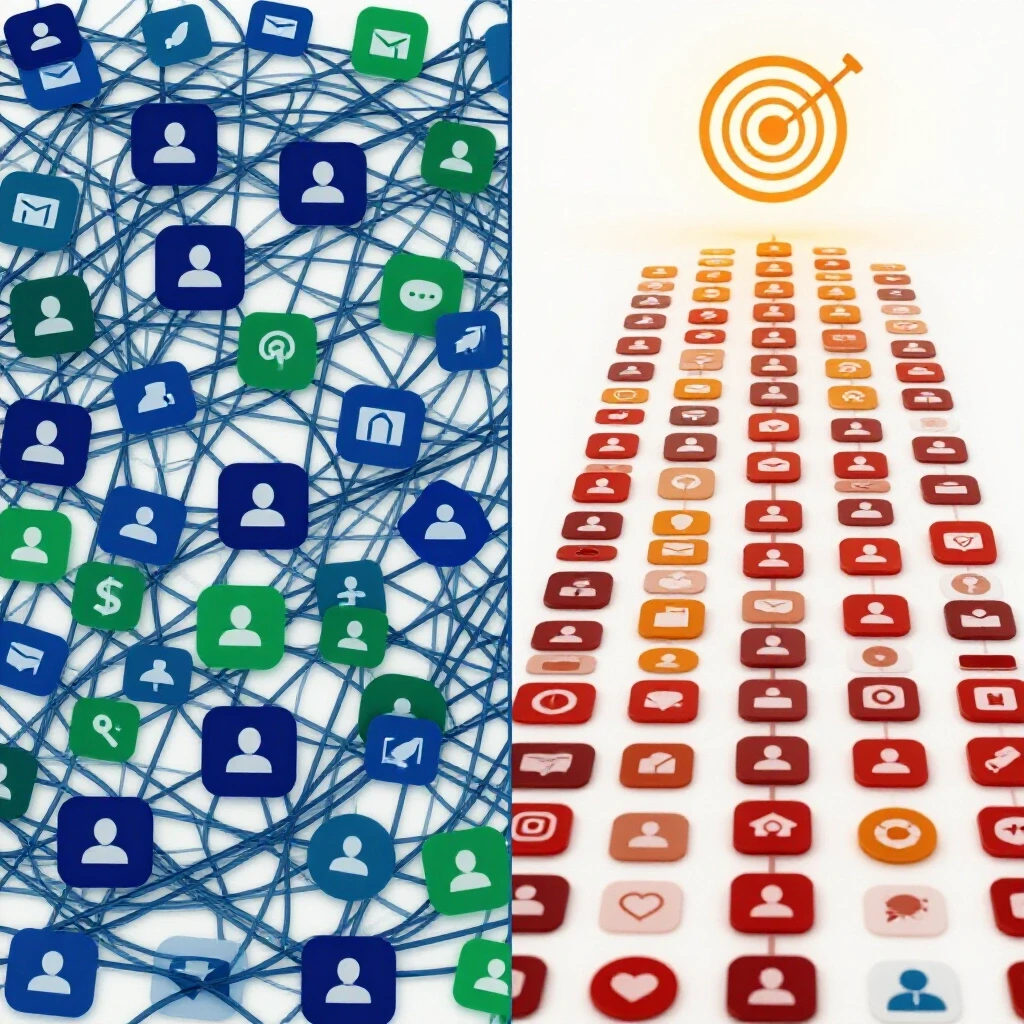
Campaign stagnation occurs when your growth metrics stop improving and your cost per lead begins to rise without a corresponding increase in value. This often happens when a strategy focuses too much on top-of-funnel volume. While a high number of leads looks good in a weekly report, it can hide a lack of real interest from the audience.
I once managed a LinkedIn campaign for a software company where we generated 500 leads in a single month. On paper, it was a massive win. However, the sales team reported that 90% of those leads were “unqualified,” meaning they didn’t have the budget or the authority to buy. We had made the lead magnet—a simple PDF—so easy to download that people were clicking it without even knowing what the company did.
This is a classic example of a targeting mismatch. We were reaching “lookalike audiences” based on broad interests rather than specific professional needs. According to Pew Research Center data, users on professional platforms like LinkedIn are more likely to engage with content that offers direct career utility. When we ignore this and go for broad appeal, we waste ad spend on people who will never convert.
To avoid this, I now use a specific budget allocation split: * 70% Core Strategy: Proven tactics that deliver steady results. * 20% Experimental: Testing new creative formats or slightly different audience segments. * 10% High-Risk: Testing “wild card” ideas that could either fail completely or lead to a major breakthrough.
| Metric Phase | Goal | Warning Sign |
|---|---|---|
| Initial Launch | 1% – 2% CTR | CTR below 0.5% after 72 hours |
| Optimization | Lower CPL by 15% | CPL stays flat despite creative changes |
| Scaling | Maintain Lead Quality | Lead-to-MQL ratio drops below 20% |
Identifying the Pivot Triggers in Your Multi-Platform Organic Growth
Algorithmic adaptation is the process of changing your content strategy to align with how social media platforms currently prioritize posts. A pivot trigger is a specific data point that tells you it is time to make this change. Recognizing these triggers early prevents you from wasting weeks on a failing strategy.
In my 11 years of tracking, I have found that the most common reason for a sudden drop in reach is “creative fatigue.” This happens when your audience has seen your ad or post too many times, and they start to ignore it. On platforms like TikTok, this can happen in as little as seven days. On LinkedIn, it might take a month.
When I see a drop in organic reach, I don’t panic. Instead, I look for these three pivot triggers:
- The 30% Rule: If my average reach drops by 30% or more over a rolling 14-day period, I initiate a content audit.
- Engagement Decay: If the ratio of comments to likes decreases, it usually means the content is no longer sparking conversation.
- Negative Feedback Loop: On Meta platforms, I check the “Hide Post” or “Report Ad” metrics. Even a small increase here can signal that your targeting is off.
Interestingly, platform reach recovery is rarely about doing more of the same. It usually requires a structural change. For example, if your static images are failing on Instagram, pivoting to Reels with a focus on “educational friction” can often reset the algorithm’s view of your account.
A Data-Backed Framework for Correcting Conversion Friction
Conversion friction refers to the obstacles a user must overcome to complete a desired action, such as filling out a form. While many marketers try to remove all friction, “intentional friction” can be a powerful tool for improving lead quality. This involves adding one or two qualifying questions to your lead forms to filter out casual clickers.
When I realized my high-volume campaigns were failing, I implemented a “Qualifying Pivot.” Instead of asking for just an email address, I added a question about the user’s biggest challenge or their current budget range.
The results were immediate: 1. Lead Volume dropped by 40%. 2. Lead Quality (MQLs) increased by 65%. 3. Cost per Acquisition (CPA) decreased by 22%.
By making the process slightly harder, we ensured that only people who were truly interested took the time to finish the form. This is a crucial lesson for any growth strategist: a smaller pool of high-intent leads is always more valuable than a large pool of disinterested ones.
To track this, I use a Retrospective Performance Matrix. This is a simple table where I compare the “ease of entry” against the “rate of conversion” over a 30-day period. If the ease is high but the conversion is low, I know I need to add more friction.
Project Management Tools for Lead Tracking
Managing these pivots requires organized data. I rely on a few specific tools to keep my campaign lifecycles visible:
- HubSpot or Salesforce: For tracking leads from the social click all the way to the closed sale.
- Supermetrics: To pull data from multiple platforms into a single Google Sheet or Looker Studio dashboard.
- Asana or Trello: To document “Pivot Logs”—notes on why a change was made and what the result was.
- Meta Ads Reporting: Specifically the “Inspect” tool to see if my audience is overlapping too much with other campaigns.
Why Sudden Stagnation Halts Growth Journeys—And How to Formulate a Real Pivot Blueprint
Marketing trend analysis involves looking at long-term shifts in how users interact with social platforms. When stagnation hits, it is often because your strategy is based on an outdated trend. For instance, the “minimalist” aesthetic that worked on Instagram in 2018 often feels “over-produced” and untrustworthy to today’s TikTok-influenced audience.
A real pivot blueprint is a documented plan for changing direction. It should not be based on a “gut feeling.” Instead, it should be a response to specific data points. I follow a four-step process when formulating a pivot for a client or manager:
- Audit the Current State: Identify exactly where the drop-off is happening (e.g., high CTR but low landing page conversion).
- Hypothesize the Cause: Is it the creative, the targeting, or the offer itself?
- Set a Test Period: I usually recommend a 14-day window for a new test.
- Define Success Metrics: What specific number needs to change to prove the pivot worked?
I remember a campaign where we were trying to get sign-ups for a webinar. For three weeks, we ran high-energy video ads with no luck. Our pivot was to switch to a very simple, text-heavy carousel that explained the three main takeaways of the event. We didn’t change the budget; we only changed the delivery of the information. Within 10 days, sign-ups doubled because the new format addressed the audience’s need for “quick-scan” value.
Communicating Strategic Adjustments to Clients and Stakeholders
Justifying a pivot can be the hardest part of a strategist’s job. Clients often fear that a change in strategy means the previous work was a “waste” of money. To manage these expectations, I use transparent timelines that show the natural lifecycle of a campaign.
I explain that every campaign goes through a “Learning Phase.” According to Meta’s advertising transparency reports, the algorithm needs about 50 conversion events per week to properly optimize. If we aren’t hitting that, a pivot isn’t a failure; it’s a necessary adjustment to reach the optimization threshold.
When presenting a pivot, I use a “Transition Log” template. This includes: * The Original Strategy: What we were doing. * The Triggering Data: The specific metric that stagnated. * The New Hypothesis: What we believe will work better. * The Risk Mitigation: How we are protecting the remaining budget (e.g., the 70/20/10 split).
By showing the data behind the decision, you move the conversation from “I think this will work” to “The data shows we need to adjust to maintain our ROI.” This builds trust and positions you as a data-driven expert rather than someone just chasing the latest trend.
Practical Steps for Post-Campaign Analysis and Long-Term Success
Post-campaign analysis is the process of reviewing all data points after a campaign has ended to find lessons for the next launch. This is where I find my most valuable insights. I don’t just look at the final lead count; I look at the “decay rate” of the creative and the “latency” of the leads (how long it took them to sign up after the first touch).
One of the most common mistakes I see intermediate marketers make is moving immediately to the next campaign without documenting the last one. I maintain a “Campaign Library” of all 40+ journeys I’ve managed. Each entry includes the original goal, the pivots we made, and the final outcome.
Here is a quick checklist for your post-campaign review: 1. Compare actual spend vs. forecasted results. 2. Identify the top-performing creative and analyze why it worked. 3. Review the lead quality with the sales team or check the backend conversion data. 4. Note any external factors, like platform outages or major news events, that might have skewed the data. 5. Update your baseline metrics for the next campaign.
Building a sustainable social media growth strategy is not about finding a “hack.” It is about a consistent process of launching, tracking, and adjusting. By embracing the reality of algorithm shifts and being transparent about your data, you can navigate the unpredictable nature of social media with confidence.
Key Takeaways for Sustainable Growth
- Prioritize Intent over Volume: Don’t be afraid to add friction to your lead forms to ensure you are getting quality contacts.
- Use the 14-30 Day Rule: Give your campaigns enough time to gather data, but don’t wait months to pivot if the numbers are stagnant.
- Document Everything: Use pivot logs and transition reports to justify your decisions to stakeholders.
- Maintain a Balanced Budget: Use the 70/20/10 rule to protect your core results while still innovating.
Frequently Asked Questions
What is a good baseline engagement rate for a new account? A good baseline depends on the platform, but for Instagram and LinkedIn, an engagement rate of 1% to 3% is generally considered healthy. On TikTok, you might expect higher engagement (4%+) but with more volatility. Always calculate this based on your specific industry benchmarks.
How do I know if my lead quality is actually the problem? Check your “Lead-to-MQL” (Marketing Qualified Lead) ratio. If you are getting 100 leads but only 5 of them are people who actually fit your target customer profile, your friction is too low or your targeting is too broad.
What should I do if my organic reach drops suddenly? First, check for platform-wide outages or algorithm updates. If the drop is specific to your account, review your recent content for “creative fatigue.” Try changing your content format (e.g., switch from images to video) for 7 days to see if reach recovers.
How much of my budget should I spend on testing new ideas? I recommend the 70/20/10 rule. Spend 70% of your budget on what you know works, 20% on variations of proven tactics, and 10% on completely new, high-risk experiments.
What is the “Learning Phase” in social media advertising? The Learning Phase is the period after you launch an ad when the platform’s algorithm is testing different audiences to see who is most likely to convert. During this time, performance can be unstable. It usually lasts until the ad achieves about 50 conversions.
How do I justify a strategy pivot to a skeptical client? Use a Transition Log. Show them the specific data point (like a rising Cost Per Lead or falling Reach) that triggered the need for change. Explain the pivot as a data-backed adjustment to protect their ROI, not a admission of failure.
Why is my cost per lead increasing even though my ads are the same? This is usually caused by creative fatigue or audience saturation. If the same people see the same ad too many times, they stop clicking. You need to refresh your visuals or copy to re-engage the audience.
Is it better to have more followers or higher engagement? For lead generation, engagement is far more important. A small, highly engaged audience that trusts your brand will produce more high-quality leads than a large, passive following that doesn’t interact with your content.
How long should I wait before declaring a campaign “stagnant”? I recommend a minimum observation period of 14 days. This allows the algorithm to move past the initial learning phase and accounts for weekly fluctuations in user behavior.
What are the best tools for tracking multi-platform growth? For intermediate marketers, I recommend using HubSpot for lead tracking, Supermetrics for data aggregation, and Looker Studio for visual reporting. These tools provide a clear view of the entire campaign lifecycle.
(This article was written by one of our staff writers, Michael Reynolds. Visit our Meet the Team page to learn more about the author and their expertise.)