Meta vs LinkedIn for B2B Ads: ROI Comparison Guide (Expert Review)
== Determining the most effective use of a B2B advertising budget often feels like a balancing act between volume and precision. In my twelve years of managing multi-million dollar accounts, I have found that the choice between Meta and LinkedIn is rarely about which platform is “better” in a vacuum. Instead, it is about which economic model fits your specific unit economics, sales cycle length, and lead quality requirements. ==
Defining the Cross-Channel Budget for Professional Services
A multi-channel advertising budget for B2B involves allocating financial resources across different social networks to capture demand at various stages of the buyer journey. This strategic distribution ensures that you are not over-reliant on a single algorithm, allowing for more stable lead flow and a more resilient customer acquisition cost over time.
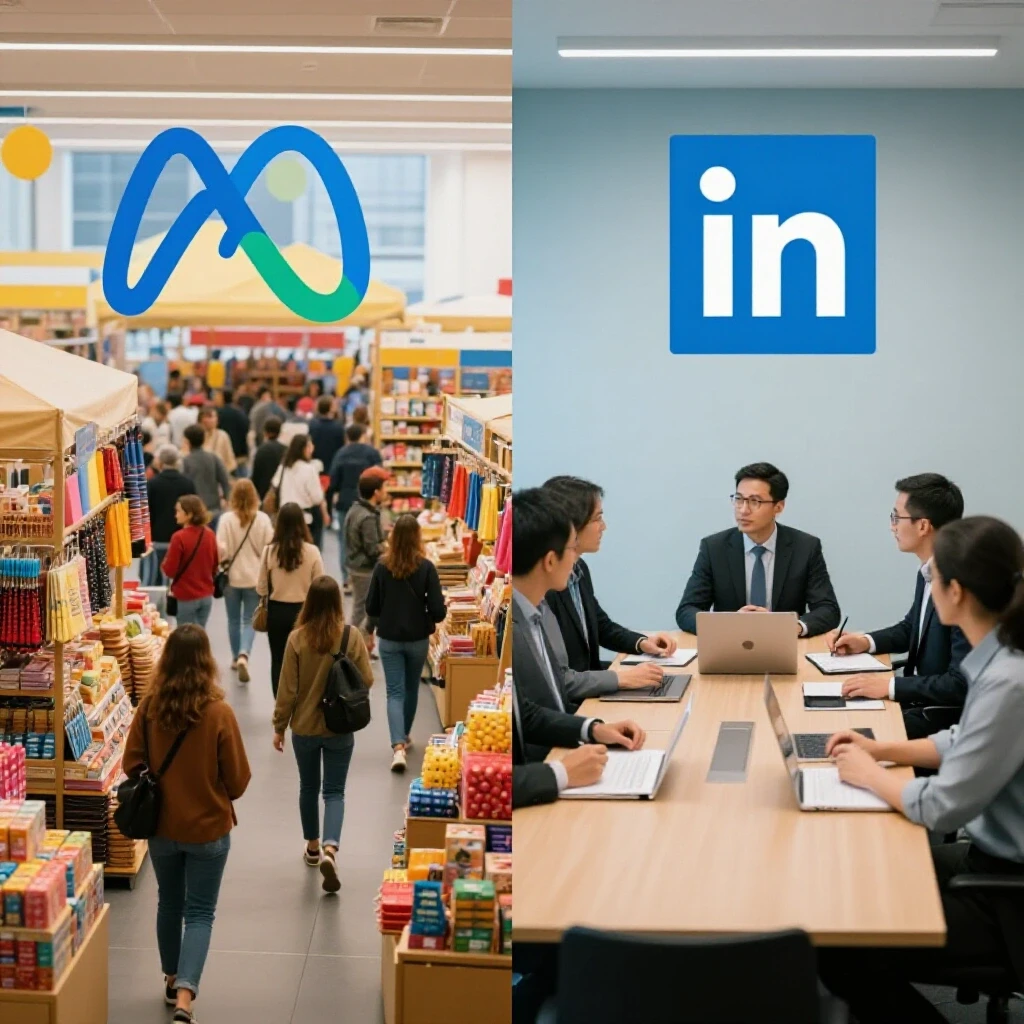
In my experience managing spend across LinkedIn, Facebook, and Instagram, the most common mistake is treating all platforms with the same budget weight. I typically follow a 50/30/20 rule. I put 50% into my core “proven” platform, 30% into a secondary channel to test scale, and 20% into emerging experiments or high-intent retargeting.
When I first started managing enterprise accounts, I tried to split budgets evenly. This was a disaster. The LinkedIn ads were too expensive for the small budget to learn, and the Meta ads generated too many low-quality leads for the sales team to handle. Now, I ground every allocation in a ROI tracking framework that looks at the blended return rather than just platform-reported numbers.
- Blended ROAS (Return on Ad Spend): This is your total revenue divided by your total ad spend across all channels. It provides a “truth” metric that accounts for the fact that a user might see a LinkedIn ad but eventually convert through a Meta retargeting campaign.
- MER (Marketing Efficiency Ratio): Similar to blended ROAS, this helps you see the big picture of how your total marketing investment is driving top-line growth.
Analyzing Customer Acquisition Cost Across Platforms
Customer acquisition cost (CAC) represents the total sales and marketing cost required to earn a new client. In the B2B space, this metric must be tracked alongside lead quality, as a low cost-per-lead (CPL) on one platform can often lead to a much higher CAC if those leads do not close.
Interestingly, Meta often wins on the raw CPL metric. I have seen campaigns where Meta leads cost $15 while LinkedIn leads for the same whitepaper cost $85. However, the cross-platform performance tells a different story when you look at the “SQL” or Sales Qualified Lead stage.
I once managed a project for a SaaS provider where we spent $50,000 on each platform over three months. Meta gave us 1,000 leads, but only 10 turned into deals. LinkedIn gave us 200 leads, but 25 turned into deals. Despite the higher initial cost, LinkedIn’s customer acquisition cost was significantly lower because the audience was more relevant to the product.
Table 1: Cross-Platform Performance Benchmarks (B2B Averages)
| Metric | Meta (Facebook/IG) | |
|---|---|---|
| Average CTR | 0.90% – 1.20% | 0.40% – 0.65% |
| Average CPL | $15 – $40 | $60 – $120 |
| Lead-to-SQL Rate | 5% – 10% | 15% – 25% |
| Audience Precision | Interest/Behavior Based | Firmographic/Job Title Based |
| Scalability | High (Broad Reach) | Medium (Niche Focus) |
Resolving Platform Attribution Gaps in B2B
Platform attribution gaps occur when the data reported in your ad manager does not match the reality of your CRM or Google Analytics. This happens because platforms often “claim” credit for a conversion even if they were just one small touchpoint in a long, complex B2B buying cycle.
To combat this, I rely heavily on first-party data loops. This means sending data from my CRM back to the ad platforms using a Conversion API (CAPI). CAPI is a way to share web events directly from your server to the ad platform, bypassing the limitations of browser-based cookies.
I remember a specific case where Meta reported a 4.0 ROAS, but our internal bank statements showed we were barely breaking even. We realized Meta was using a 1-day view-through attribution window. This meant if someone saw an ad and then bought later that day via a direct search, Meta took 100% of the credit. By moving to a 7-day click-only model, we got a much more realistic view of our ad spend justification.
- View-through Attribution: This counts a conversion when someone sees an ad but does not click it, yet converts later.
- Click-through Attribution: This only counts the conversion if the user actually clicked the ad before buying.
- 7-to-14-Day Attribution Checks: I recommend reviewing performance every 7 to 14 days to allow the platform algorithms enough time to process data and show patterns.
Creative Execution and Platform Bid Strategies
Creative execution refers to the visual and written elements of your ads, while bid strategies are the rules you set for how much you are willing to pay for a specific action. Different platforms require different creative “languages” to be successful in a professional context.
On LinkedIn, I find that “Single Image” ads with a heavy focus on data or industry insights perform best. On Meta, I often use “Dynamic Creative Optimization” (DCO). DCO is a tool that takes multiple images, headlines, and descriptions and automatically tests different combinations to see which one works best for each user.
When it comes to bidding, I generally avoid “Lowest Cost” bidding for B2B on Meta. It tends to find the “cheapest” people who might just be “click-happy” rather than actual buyers. Instead, I use “Cost Caps.” A cost cap tells the platform, “I am willing to pay an average of $50 per lead, and if you can’t find them at that price, don’t spend my money.” This discipline has saved my clients thousands of dollars during competitive holiday seasons.
- Meta Creative: Focus on the “human” side of the business. Use video testimonials or behind-the-scenes content.
- LinkedIn Creative: Focus on the “professional” side. Use PDF carousels that offer immediate value or checklists.
- Testing Parameters: Always run A/B tests for at least 14 days before making a major budget shift.
Ad Spend Justification and Executive Reporting
Ad spend justification is the process of proving to your board or clients that the money being spent on ads is generating a positive financial return. This requires moving away from “vanity metrics” like likes or impressions and focusing on pipeline value.
In my reporting, I use a “Target CPA Limit.” This is the maximum amount we can spend to acquire a lead while still remaining profitable. If the LinkedIn CPA stays above this limit for more than three weeks despite optimizations, we reallocate that budget to Meta or another high-performing channel.
I once had a client who was furious that our LinkedIn CTR (Click-Through Rate) was only 0.4%. They compared it to their Meta CTR of 1.5%. I had to explain that the LinkedIn audience was 100% CEOs of companies with over 500 employees. The Meta audience was “anyone interested in business.” While the LinkedIn ads were clicked less often, the people who did click were ten times more valuable. We eventually proved this by mapping the Customer Lifetime Value (LTV) of the leads from both sources.
- LTV Mapping: Tracking how much a customer spends over their entire relationship with your company.
- Standard Feedback Loops: Weekly meetings between the media buyer and the sales team to discuss lead quality.
Practical Steps for Evaluating Your Media Mix
To effectively compare these two giants, you need a structured approach. I have developed a checklist that I use every time I audit a B2B account to ensure the budget is being used wisely.
- Verify Tracking: Ensure the Meta Pixel and LinkedIn Insight Tag are firing correctly on all key pages.
- Set Up Conversion API: Connect your CRM to your ad accounts to track offline conversions.
- Define Your “North Star” Metric: Is it Cost Per Lead, Cost Per Meeting, or Cost Per Sale?
- Run a Split Test: Allocate a small, equal budget to both platforms using the exact same offer and landing page.
- Analyze Funnel Depth: Don’t just look at who signed up; look at who moved to the next stage of your sales process.
Table 2: Budget Allocation Strategy by Funnel Stage
| Funnel Stage | Recommended Platform | Primary Goal | Metric to Watch |
|---|---|---|---|
| Top (Awareness) | Meta | Reach & Brand Recall | CPM (Cost Per 1,000 Impressions) |
| Middle (Consideration) | Thought Leadership | Content Downloads / CTR | |
| Bottom (Conversion) | LinkedIn / Meta Retargeting | Demo Requests | CPA (Cost Per Acquisition) |
Common Mistakes in B2B Multi-Channel Management
One of the biggest mistakes I see is neglecting “First-Party Data.” With privacy updates from Apple and Google, third-party cookies are less reliable. If you aren’t uploading your own customer lists to create “Lookalike” or “Matched” audiences, you are leaving money on the table.
Another error is failing to adjust for the “weekend effect.” In B2B, LinkedIn performance often craters on Saturdays and Sundays, while Meta can remain steady as people browse in their personal time. I often use automated budgeting tools to scale down spend on weekends for LinkedIn to preserve the budget for high-traffic Tuesday mornings.
Finally, don’t ignore the “Dark Social” element. Many B2B buyers see an ad, don’t click it, but then search for your brand later. This is why a holistic view of your cross-platform performance is essential. If you turn off Meta because it has a low “direct” ROAS, you might find your LinkedIn conversion rate drops because Meta was doing the heavy lifting of building initial brand trust.
FAQ: Navigating the Economics of B2B Paid Social
Which platform typically has a better ROI for B2B?
Why is LinkedIn so much more expensive than Meta?
LinkedIn’s “Professional Graph” allows you to target by specific job titles, company sizes, and industries. This data is highly verified and valuable. Because the audience is smaller and more “in-market” for business solutions, the competition for their attention drives up the cost.
Can I use Meta for high-ticket enterprise B2B?
Yes, but it works best as a retargeting tool. You can use LinkedIn to reach the right people initially, then use Meta to stay “top of mind” while they are browsing their personal feeds. This lowers your overall customer acquisition cost.
How do I justify a high CPL on LinkedIn to my boss?
Focus on the “Lead-to-Close” ratio. Show that while a LinkedIn lead costs $100 and a Meta lead costs $20, the LinkedIn leads are five times more likely to become paying customers. Use a table to show the final “Cost Per Sale” to make your point.
What is the most important metric for cross-platform performance?
In my 12 years of experience, the most important metric is the “Blended Cost Per Qualified Lead.” This combines all your spend and looks at the total number of leads that actually meet your sales team’s criteria.
How long should I test a platform before giving up?
I recommend a minimum of 30 to 60 days. B2B sales cycles are long. If you only test for a week, you aren’t seeing the full impact of the “nurture” process that social ads provide.
Does the Meta “Advantage+” feature work for B2B?
It can work well for broad awareness, but I prefer manual control for B2B. Advantage+ often prioritizes volume over quality, which can lead to a lot of “junk” leads that frustrate your sales team.
How do I handle tracking discrepancies between platforms?
Always use UTM parameters on every link. This allows you to see the “Last Click” source in your own analytics or CRM, providing a neutral third-party view that isn’t biased by the platform’s own reporting.
Should I use Lead Gen Forms or Landing Pages?
Lead Gen Forms (native to the platform) usually result in more leads and a lower CPL. However, Landing Pages often result in higher-quality leads because the user has to take more effort to fill out the form. I suggest testing both simultaneously.
What is a “good” conversion rate for a B2B ad?
For a gated whitepaper or webinar, a 15% to 30% conversion rate on the landing page is standard. For a “Request a Demo” ad, a 2% to 5% conversion rate is more realistic. Always benchmark against your own historical data rather than “industry averages.”
(This article was written by one of our staff writers, James Harrington. Visit our Meet the Team page to learn more about the author and their expertise.)